Monday, August 18, 2025

Genre Spotlight 54: Ice Walk (Puzzles 326 and 327)

Today's genre has started to gain some popularity in the wider puzzle sphere, but is still niche enough that it probably works for the Spotlight.  Ice Walk is a Nikoli genre that didn't really take off until it was ported it to puzz.link several years later.  This type is very good, and I'm glad it is getting the recognition it deserves.  (Please, Nikoli, make a sequel to the Omopa collection!)

Rules: Draw a loop through the centers of some cells which passes through each numbered cell. Two perpendicular line segments may intersect each other only on icy cells, but they may not turn at their intersection or otherwise overlap. The loop may not turn on icy cells. A number indicates how many cells make up the continuous non-icy section of the loop that the number is on.


Monday, August 11, 2025

Genre Spotlight 53: Hasu no Mura (Puzzles 324 and 325)

For today's genre, I wanted to try something different.  Hasu no Mura is a fairly recent type, first appearing on PuzzleSquareJP in 2023.  It has had modest success on the platform ... but I could not, for the life of me, wrap my head around the clues.  This week, I wanted to try and understand this genre a little more, and this mission was a success.  While this type is still not one of my favorites, I do appreciate the genre a bit more.

Rules: Shade a connected network of orthogonally connected cells.  No 2x2 square may be fully shaded.  Clues cannot be shaded, and represent the sum the areas of all unshaded regions diagonally adjacent to it.  If a region uses multiple of these cells, it is only counted once. 


Monday, August 4, 2025

Genre Spotlight 52: Tawamurenga (Puzzles 322 and 323)

Today's genre is a bit more well-known than some of the others in this series, but only because it has an implementation on puzz.link.  The name "Tawamurenga" may be easy to confuse with "Tapa", but the genres are quite different.  Tawamurenga is a Nikoli Omopa type dating to volume 127.

Rules:  Shade several cells in the grid.  Cells with numbers cannot be shaded and indicate the number of shaded cells adjacent to it (up to 6).  There can not be a horizontal run of 3 or more shaded cells.  Each shaded cell must have at least one shaded cell below it (unless it's on the bottom row).


(Example taken from puzz.link.  One interesting point that isn't mentioned in this example: the shaded cells, overall, need not be connected.)

Monday, July 28, 2025

Genre Spotlight 51: Miti (Puzzles 320 and 321)

I found today's genre on janko.at one point and thought it was an interesting idea.  Miti is a genre by Nishiyama Yukari, a vintage puzzle constructor from Japan.  Like Hurdle, it rephrases a full loop into a one-cell-wide path, which creates an interesting feel.  More detailed thoughts about this genre may be spoiler-y, so I've opted to wait until after the puzzles to discuss them.

Rules:  Draw segments on the dotted lines to create a loop one cell wide which passes through all squares.  Black circles indicate all vertices, including those on the edge, where exactly three lines meet at a point.  There may be no vertices where four lines meet.


Monday, July 21, 2025

Genre Spotlight 50: Magatama (Puzzles 318 and 319)

Wow, we've made it to 50 genres!  I would say "here's to 50 more", but my pace isn't fast enough for that.

Today's genre is Magatama.  I'm completely unaware of the origins of this genre -- it appears in Eric Fox's ruleset and has a few puzzles on PuzzleSquareJP, but that's all I know.  (Because the genre is probably Japanese, and because Magatama is a normal word, searching for it on the internet is pretty much impossible.)  As always, please let me know if you're aware of its origins!

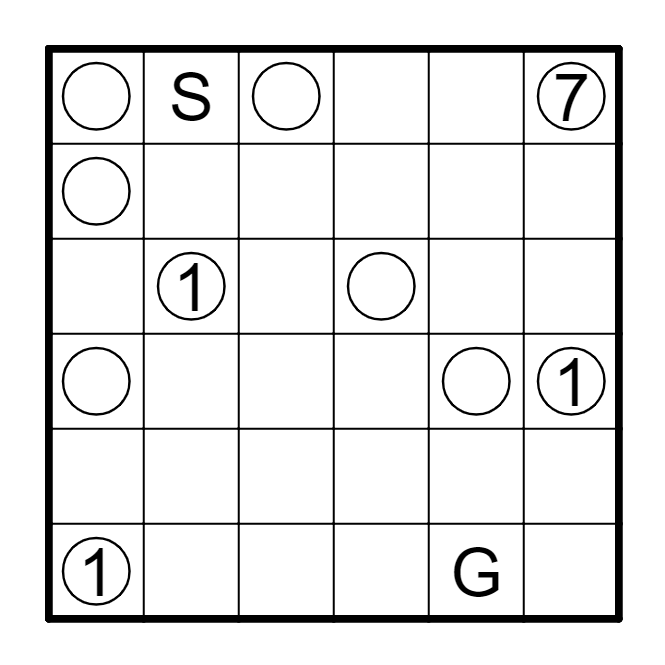
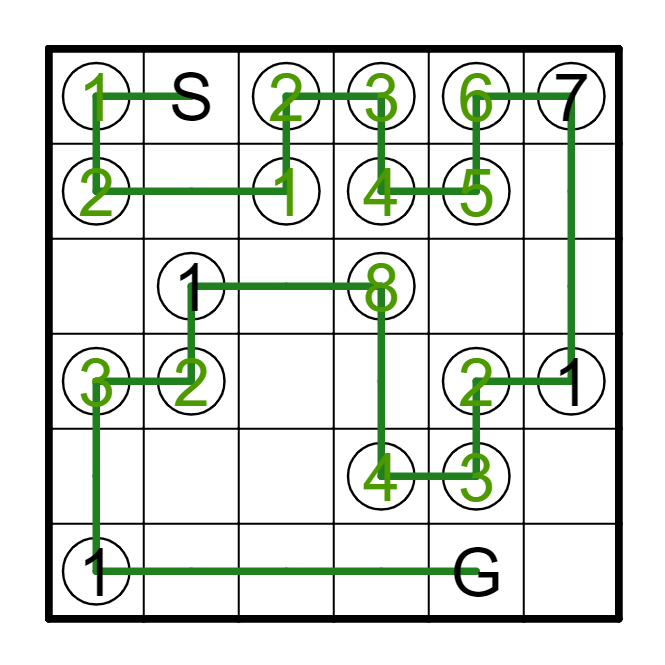
Rules: Draw a non-intersecting path through the centers of some cells, starting from the S (start) and finishing at the G (goal). Additionally, circle every cell in which the path makes a turn. Some circles are already given. A number X in a circle indicates the it’s the Xth circle in its orthogonally connected group to be visited by the path. 

https://firebasestorage.googleapis.com/v0/b/puzzle-square.appspot.com/o/img%2Fpuz_kind%2F177_example.png?alt=media&token=b882e401-e779-4308-bf87-da5524b9d85b      まがたまの例題の解答

(Example taken from PuzzleSquareJP.  Take special note of the circle marked "8" -- the circles in an orthogonally connected group do not need to be visited consecutively!)

Monday, July 14, 2025

Genre Spotlight 49: Sanctuary (Puzzles 316 and 317)

 For today's genre, we're diving back into the depths of Nikoli Omopa.  Sanctuary (サンクチュアリ) first debuted in Nikoli issue 63.  The editors of the Omopa Compendium describe the type as "extremely heavy", and by Nikoli standards, I'd probably agree.  However, each of the moving parts comes together to create an interesting mix between Fillomino and Santoitchi.

Historically, Sanctuary has been presented as a number placement genre.  However, I've modified the rules slightly to emphasize its region division components, which I think are more natural to work with. 

Rules: Shade some cells on the board and divide the remaining cells into regions.  Each region contains exactly one given number equal to its area.  Regions with the same area may not be adjacent.  Shaded cells may not touch orthogonally, and no 2x2 square may be entirely unshaded.


(Example by カルコゲン on PuzzleSquareJP.)

Monday, July 7, 2025

Genre Spotlight 48: Serpent Sum (Puzzles 314 and 315)

Today's genre Serpent Sum may be a contender for the most obscure type in the series: while the genre appears on PuzzleSquareJP, the only puzzles I've seen are from the original author in 2022.  Regardless, it's an interesting type bears quite a few similarities to San Anko.  Also, I've been told that Adders is a much better name, and while I agree, I wanted to keep the original name for consistency reasons.

Rules: Place numbers into some empty cells such that each orthogonally connected group forms a sequence of consecutive numbers from 1 to N, where N is given outside the grid. Each number in the sequence must be orthogonally adjacent to the next. These groups may not share an edge with one another.  Clues in black cells indicate the total value of the numbers in the white squares in the direction of the arrow, up to the outer perimeter or a black square. 


Wednesday, July 2, 2025

Genre Spotlight Small Update II

Hey, hi!

I'm making this post to announce a change in the Genre Spotlight series.  For the past six months, I've been making two posts a week, and while this pace has been sustainable, it's been more taxing than I first thought.  Thus, I'm making the decision to reduce the post schedule down to Mondays only, i.e. once a week.  I hope this is not disappointing to the (probably single-digit) regular viewers of my content, but I hope that I'll be able to focus a bit more on each post rather than push everything off to the last minute.

This means there will not be a post tomorrow, but there will be one on Monday.

~David